 Account Direct
Is paying myself a business expense?
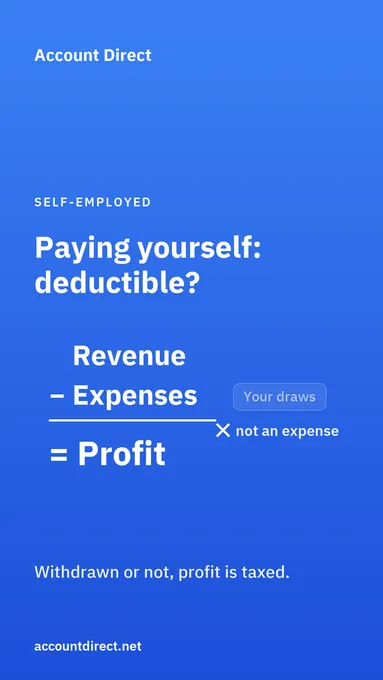
The equation your tax bill actually uses
A transfer from the business account to your personal account feels like paying yourself, and it is. It is just not an expense.
The Income Tax Act sets the base in one sentence at subsection 9(1): a taxpayer's income for a taxation year from a business is the taxpayer's profit from that business for the year. Profit is revenue minus the expenses you incurred to earn it. Your draws never enter that calculation, in either direction.
Two rules explain why. Section 18 says no deduction may be made for an outlay or expense except to the extent it was made for the purpose of gaining or producing income from the business, and it separately bars personal or living expenses of the taxpayer. Moving your own money to your own account does not buy anything that earns revenue, and what you spend it on afterward is personal.
The CRA states the conclusion without hedging. On line 9060 of Form T2125, the salaries and wages line, it says not to include salaries or drawings of the owners of the business, "since salaries or drawings paid or payable to you or your partners are not deductible."
Where a draw does belong on the form
Drawings are not invisible. They have their own line, just not in the expense column.
Form T2125 has a Part 9, Details of equity, and line 9932 is Drawings in the current year. Line 9933 beside it is Capital contributions in the current year, which is the same movement in reverse: personal money you put into the business, business debts you paid with personal funds, personal assets you transferred in.
The CRA's definition of a drawing is wider than most people assume. It is any withdrawal of cash, including salaries, or of other assets or services of the business by the proprietor or partners. It covers withdrawing cash for non-business use, and it covers using business assets and services for personal use, with the cost or value of that personal use included in your drawings for the year. The laptop bought by the business and used at home in the evening is part of this picture.
Leaving the money in does not help either
The mirror image trips up just as many people. Money left in the business account is still taxed.
Profit is taxable in the fiscal period it is earned. And because all self-employment income other than farming, fishing, and self-employed commission income must be reported on the accrual method, the CRA's own wording is that you report income in the fiscal period you earn it, no matter when you receive it, and deduct expenses in the period you incur them whether or not you paid them.
So a December invoice paid in February is taxed in the earlier year. A healthy balance in the account on December 31 does not defer anything. The net figure from the form goes to line 13500 of your return, with the gross on line 13499, and that is the number the tax is built on.
Why the corporate advice does not transfer
Most of the confusion comes from advice written for corporations, where paying yourself really is a deduction.
A corporation is a separate taxpayer. When it pays an owner who works in the business a salary, that salary is a deductible expense to the corporation and employment income to the person, run through payroll with source deductions and a T4 slip. Dividends work differently again: they come out of profit that has already been taxed in the corporation, so they are not deductible.
A sole proprietorship has none of that machinery, because there is no second party. You and the business are one taxpayer, which is exactly why the transfer cannot be a deduction.
The habit that keeps this clean
Pay yourself on a schedule out of a dedicated business account, and record each transfer as a draw rather than as an expense. It keeps the profit figure honest all year instead of forcing a cleanup at filing time.
Then treat the tax as a separate reservation. Your bill is driven by profit, not by what you kept, so a good month means more tax whether or not you touched the money. For the 2026 tax year, a self-employed return is due June 15, 2027, but any balance owing is due April 30, 2027, which is the date that catches people who planned around the later one.
If the draws in your books are currently mixed in with the expenses, that is a bookkeeping fix, not a lost deduction. The profit was always the number.
Frequently asked questions
If I take nothing out of the business, do I owe less tax?
No, not as a sole proprietor: the two things are unrelated. You are taxed on the profit of the business for the fiscal period, and whether that profit is still sitting in the business account on December 31 or was transferred to your personal account in March changes nothing about the amount. (A corporation is different, because the owner's personal tax follows what is actually paid out as salary or dividend.) The accrual method pushes it one step further: you report income in the fiscal period you earn it, no matter when you receive it, so an invoice you issued in December and got paid for in February is taxed in the earlier year. Leaving money in the account is a cash-flow decision, not a tax strategy.
Can I put myself on payroll as a sole proprietor?
No. There is no employer and employee here, only one taxpayer, so a wage paid to yourself is not a deductible expense. The Canada Revenue Agency states it plainly on line 9060 of Form T2125: salaries or drawings paid or payable to you or your partners are not deductible. What you can deduct is a salary paid to your spouse, common-law partner, or child, provided the work is genuinely necessary to earn the business income and the amount is what you would pay anyone else for it, with a T4 slip issued the same as for any other employee.