Do your books match your bank statement?
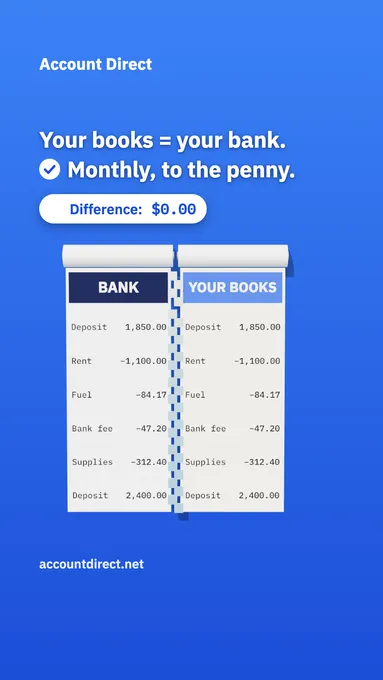
Two documents that should tell the same story
On one side, your bank statement: what the bank actually saw go in and out of the account. On the other, your books: what you recorded. Every month, those two documents should tell exactly the same story.
A bank reconciliation is how you check. You take every line on the statement and find its twin in your books, to the penny. When everything is paired, the balance in your books and the balance on the statement agree. When a line is left over, there is a difference to explain.
One forgotten line is enough
The gap rarely comes from a big mistake. Most of the time it is a small amount nobody thought to record:
- monthly service fees or transaction fees;
- interest charged on a line of credit;
- an automatic withdrawal (software, insurance, phone);
- a deposit recorded twice, or not at all;
- two transposed digits, like $47.20 recorded as $42.70.
On its own, each of these looks harmless. But until it is found, the balance in your books is wrong, and everything built on it is wrong too.
Why every month, not once a year
A gap spotted the same month takes minutes to fix: the statement is short and the transactions are fresh in your mind. The same gap found twelve months later is buried in hundreds of lines, and several small misses can add up or cancel out, which makes them even harder to track down.
A monthly reconciliation also pays off in a concrete way: it surfaces expenses you forgot to record. Bank fees on your business account are a business expense; if they never make it into your books, they never reduce your taxable income.
Records that hold up
Tax authorities expect a business to keep records and books that support its income and expenses, and to hold on to them for years. A reconciliation done every month shows your books rest on the account's real transactions. That is exactly what you want to be able to demonstrate if the tax authorities ever ask questions.
How to do it
- Start from the month-end balance on the statement.
- Tick every statement transaction that also appears in your books.
- Record in your books whatever is missing (fees, interest, withdrawals).
- Note the items in transit: a cheque written but not yet cashed, a deposit made on the 31st and credited on the 2nd.
- Check that the two balances agree once those items are accounted for.
If the difference does not reach zero, do not move on to the next month: that is the moment to look.
At Account Direct, we reconcile as we keep your books, every month, before a small gap turns into a big headache.
Frequently asked questions
How often should I reconcile my bank account?
Every month, as soon as the statement is available. A one-month gap takes minutes to find; a gap left for twelve months can take hours to untangle.
What if I cannot find the difference?
Compare line by line, ticking each transaction on both sides. The usual culprits are unrecorded bank fees, a duplicated entry, transposed digits, or a deposit recorded in the wrong month.