Business in the red this year? Report the loss anyway
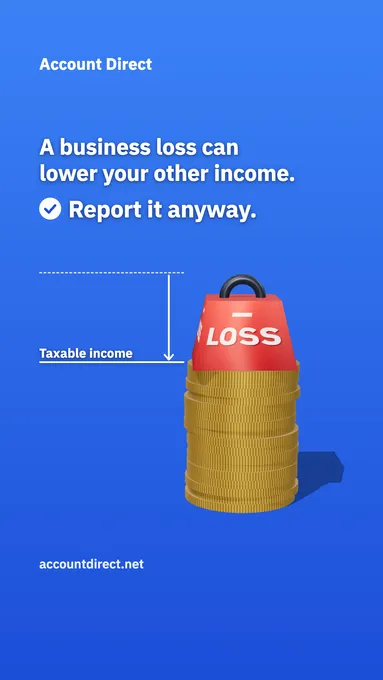
A bad year is still a year to report
Sales didn't come in, the expenses kept going, and the business finished the year in the red. Many self-employed people conclude there is nothing to report, since there was no profit.
It's the opposite. A business loss, reported properly, can save you tax.
The loss reduces your other income for the year
When your income for the year is worked out, your sources of income are added up and your losses from an office, employment, business or property are then subtracted.
In practice, if you also earn a salary, investment income or another source of income, your business loss brings it down. A simple example: a $50,000 salary and an $8,000 business loss give you $42,000 of income. Tax is then calculated on $42,000, not $50,000.
The loss is reported with your business's statement of income and expenses, filed alongside your personal tax return.
What if the loss is bigger than all your other income?
The part you can't use in the year doesn't vanish. It generally becomes a non-capital loss, which you can carry back to the three previous years (to recover tax already paid) or forward to the next twenty years (to reduce tax in a more profitable year).
For that to work, the loss has to be reported. A loss that never appears on a return is a loss nobody can find later.
One important condition
It has to be a genuine business, run with a commercial purpose. A personal pursuit or hobby that costs money does not give you a business loss. Up-to-date books, invoices and a business plan help show the activity is commercial, especially when losses repeat.
What we do
We keep your books straight in the lean years too. We record the loss clearly, report it on your return, and track carryforward losses from year to year so they're used at the right time.
Frequently asked questions
What if my loss is bigger than all my other income for the year?
The unused part generally becomes a non-capital loss. It can be carried back to the three previous years or forward to the next twenty years to reduce taxable income in those years.
Does any activity that loses money give me a business loss?
No. It has to be a genuine business, run with a commercial purpose. A personal pursuit or hobby with no commercial aim does not produce a deductible business loss.