Can I deduct my cell phone if I am self-employed?
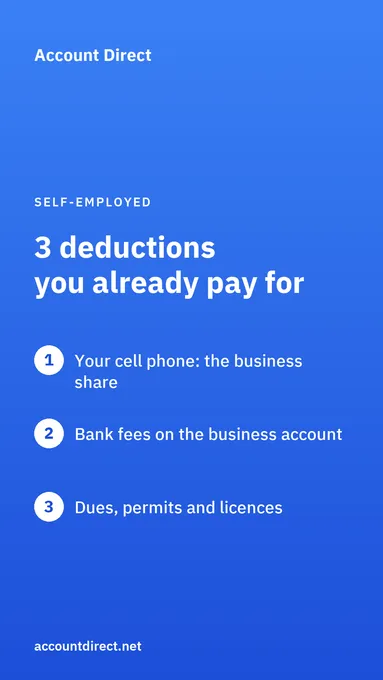
The expenses that hide in plain sight
Most self-employed people go looking for deductions in the wrong place. They hunt for something unusual to claim, while three ordinary charges leave their bank account every single month and never make it onto the return. Nothing exotic, nothing aggressive, just money already spent on running the business.
1. Your cell phone, in proportion
You can deduct the percentage of airtime expenses for a cellular telephone that reasonably relates to earning your self-employment income. Revenu Québec is even more explicit and includes the cost of acquiring a plan or prepaid airtime, calculated in proportion to your business use.
The arithmetic is simple. An $80 monthly plan used half for work is $960 a year, of which $480 is deductible.
Two limits are worth knowing. Buying the handset is not an expense you write off in the year, it is capital cost allowance claimed over time. And the basic monthly charge for a home telephone line is treated far more strictly, so do not fold it into the same claim.
2. Bank fees on the business account
Monthly account fees, transaction charges, transfer fees. Both the CRA and Revenu Québec allow you to deduct management and administration fees, including bank charges, incurred to run your business.
They are small individually and invisible on a return that never claims them. A business account at $20 a month is $240 a year, before per transaction charges.
One detail we watch: most bank service charges are exempt financial services under the Excise Tax Act, so there is generally no GST or QST sitting on them to recover. Where you do recover sales tax on an expense as an input tax credit, you deduct the expense net of that credit, not the full amount.
3. Dues, permits and licences, with a Quebec twist
Federally, a self-employed person deducts annual licence fees, trade or commercial association dues, and subscriptions to publications as business expenses. Club dues are the exception: if the main purpose of the club is dining, recreation or sport, they are not deductible.
Quebec diverges here, and this is the one that costs people money. Permits and licences required to carry on your business stay deductible. But annual dues paid to a professional association to maintain a legally recognized professional status are not deducted from your business income in Quebec. They give you a non-refundable tax credit instead, at line 397 of the provincial return. The portion covering professional liability insurance remains deductible, as do amounts paid to a professional association for any other purpose.
So the same receipt is claimed one way federally and another way provincially. That is not a detail a spreadsheet catches.
The condition behind all three
It never changes: an expense incurred to earn business income, reasonable in the circumstances, supported by a document. The part of any expense attributable to personal use is not deductible, and records must be kept generally for six years from the end of the last tax year they relate to.
What this means for you in 2026
Pull three months of statements and mark every recurring charge tied to the business. That short list is usually worth more than the deduction you were searching for. Capturing it correctly on both returns is the bookkeeping we do for you.
Frequently asked questions
Can I deduct the cost of buying the phone itself?
Not as an outright expense in the year you buy it. The Canada Revenue Agency is explicit that if you buy a cellular telephone you cannot deduct the cost. What you can deduct is the portion of capital cost allowance that reasonably relates to earning your business income, claimed over several years, plus the portion of any interest you paid on money borrowed to buy the equipment. Revenu Quebec takes the same position. The monthly plan and the airtime are the part that gets deducted in the year, prorated to business use. So the handset and the plan follow two different rules, and it is worth separating them on the invoice.
How do I prove the business portion of my cell phone?
With a percentage you can explain and a document behind it. The law does not give you a fixed rate to apply, it asks for an amount that is reasonable in the circumstances and that you can support. Keep the monthly bills, and be able to say how you arrived at your percentage, for example from the share of calls or data tied to client work. You are required by law to keep records supporting every expense claim, generally for six years from the end of the last tax year they relate to. A percentage you can justify and apply consistently holds up. A round number invented at filing time does not.