What tax mistakes cost the self-employed the most?
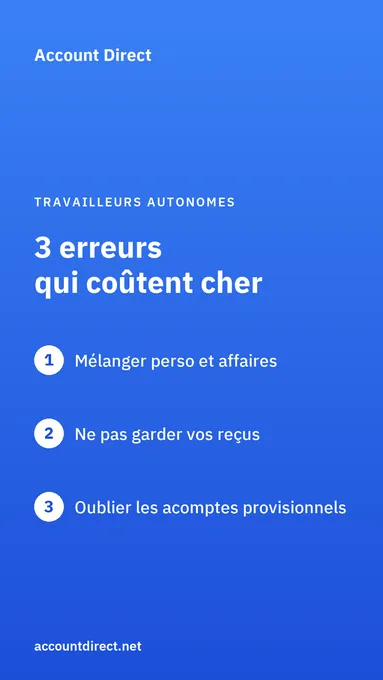
Being your own boss means being your own bookkeeper
When you work for yourself, no employer withholds your tax or files your paperwork. To the CRA and Revenu Québec, a sole proprietor and their business are the same person, so the discipline that keeps you onside is on you. The same three mistakes come up again and again, and each one is easy to avoid once you know it is there.
Mistake 1: mixing personal and business money
When your business and personal spending run through one account, it becomes hard to see which expenses are genuinely deductible, and just as easy to miss ones you are entitled to claim. As a sole proprietor you are not required to hold a separate account, but keeping one makes your books clean and your return simple to defend if the CRA or Revenu Québec ever reviews it. A dedicated business account and a separate card are the simplest fix, and they make every other part of your bookkeeping faster.
Mistake 2: not keeping your receipts
A deduction you cannot support is a deduction you can lose. The CRA and Revenu Québec both require your business records and supporting documents to be kept for six years from the end of the tax year they relate to. Without the receipt behind an expense, that expense can be disallowed on review, and the tax you thought you had saved comes back, with interest. A clear digital copy is generally accepted, so a photo taken the day the receipt lands in your hand is enough to build that six year trail.
Mistake 3: forgetting your tax instalments
As an employee, tax comes off every paycheque. When you are self-employed, nobody withholds it for you, so the CRA and Revenu Québec expect you to pay through the year in instalments once you owe enough.
- Federally, you generally have to pay by instalments if your net tax owing is more than 3,000 dollars, or 1,800 dollars if you live in Quebec, in the current year and in either of the two previous years.
- With Revenu Québec, you have to make instalments if your net income tax is more than 1,800 dollars in the current year and in either of the two previous years.
Instalments are due four times a year: March 15, June 15, September 15, and December 15. Miss them or pay late and interest applies, and in some cases a penalty on top. Setting money aside for tax as you earn it is what keeps the balance from being a shock when you file.
What this means for you in 2026
These are ordinary mistakes with ordinary fixes: separate your money, keep every receipt, and plan for your instalments. When your books are kept for you, the first two happen on their own and the third stops being a guess. We can handle that part with you, so being your own boss does not have to mean being your own accountant.
Frequently asked questions
Do I have to pay tax by instalments if I am self-employed?
Only once you owe enough. Federally, you generally have to pay by instalments if your net tax owing is more than 3,000 dollars, or 1,800 dollars for Quebec residents, in the current year and in either of the two previous years. Revenu Québec applies its own 1,800 dollar threshold. Below those amounts, you simply pay your balance when you file.
How long do I need to keep my receipts?
The CRA and Revenu Québec both require business records and supporting documents to be kept for six years from the end of the tax year they relate to. A clear scanned or photographed copy is generally accepted, so you do not have to hold on to every paper original.