Bought stock this year? Is it all an expense?
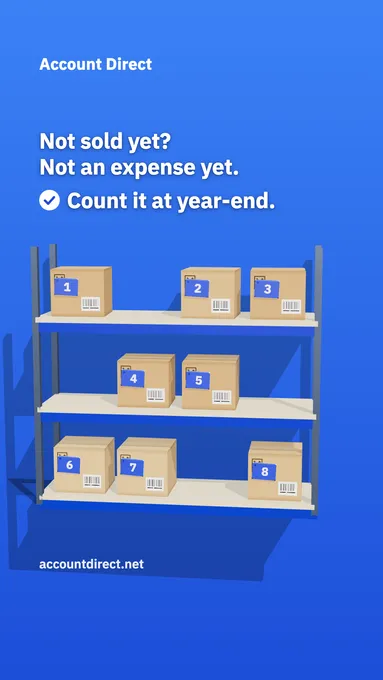
Buying stock is not an expense yet
If you resell products, you probably bought merchandise all year long. Plenty of self-employed people and small businesses add up every purchase invoice and deduct the whole amount.
That is not how it works. As a rule, the cost of goods you buy for resale is deducted in the fiscal period you sell them, not the one you buy them in. Whatever is still on the shelf at year-end gets counted, not deducted.
The year-end count
To know what you sold, you need to know what is left. At the end of each fiscal period, you do an actual count of the stock still on hand. The one exception: a perpetual inventory system, where you do periodic counts and keep a written record of each one.
That count gives you your closing inventory. It combines with two other figures to work out your cost of goods sold:
- your inventory at the start of the fiscal period;
- your purchases for the period (net of discounts);
- your inventory at the end of the period.
Cost of goods sold = opening inventory + purchases - closing inventory.
A simple example
First year in business: no opening inventory. You buy $20,000 of merchandise. At year-end, $6,000 of product is still on the shelves.
Your cost of goods sold is $14,000, not $20,000. The remaining $6,000 is not lost: it becomes next year's opening inventory and is deducted when those products sell. In fact, your inventory at the start of a fiscal period has to match your inventory at the end of the previous one.
How to value what is left
Two methods are allowed: value your entire inventory at fair market value, or value each item at its cost or fair market value, whichever is less. Cost also includes what you spend to bring the item to your business and get it ready to sell. Once you pick a method, you have to use it consistently.
What we do
We work out your cost of sales from a real count. We help you prepare the year-end count, apply the right valuation method, and carry your inventory forward from one year to the next, so every purchase is deducted at the right time.
Frequently asked questions
Do I really have to count my stock every year?
Yes, at the end of each fiscal period, unless you keep a perpetual inventory system. In that case you do periodic stock counts and keep a written record of each count.
How do I value the stock left at year-end?
You can value your entire inventory at fair market value, or value each item at its cost or fair market value, whichever is less. Once you choose a method, you have to use it consistently from year to year.