Can't pay your tax balance? Why you should file on time anyway
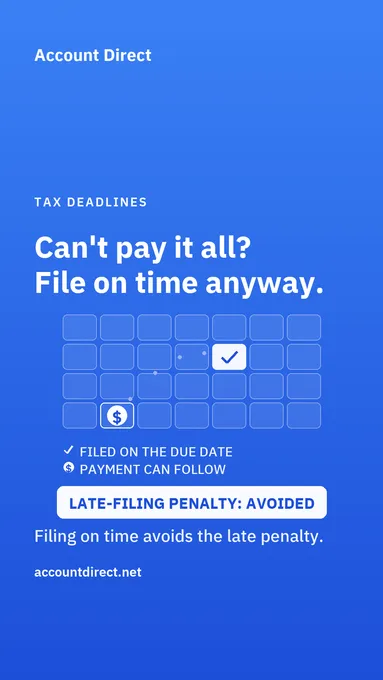
A tight month is not a reason to file late
The deadline arrives, the return is almost ready, and the balance owing is more than what is in the bank. The natural reflex is to wait: file when the money is there.
That reflex is the expensive one. Tax law treats two things separately: filing the return and paying the balance. Missing the filing deadline and missing the payment deadline do not cost the same.
What filing late costs
Subsection 162(1) of the Income Tax Act sets the late-filing penalty for a return of income. It is the total of:
- 5% of the tax that was unpaid when the return was due, and
- 1% of that same unpaid tax for each complete month the return is late, up to 12 months.
Two words carry the rule: unpaid and late. The penalty is calculated on the balance you still owed at the deadline, and it only exists because the return itself was not filed on time.
A simple example: $10,000 of tax owing, nothing paid, return filed three complete months after the deadline. The penalty is 5% plus 3%, so 8%, or $800. Filed on the deadline with the same $10,000 unpaid, the late-filing penalty is zero.
It can get heavier. If you were already charged a late-filing penalty in one of the three previous years and the CRA sends a formal demand to file, subsection 162(2) raises it to 10% of the unpaid tax plus 2% per complete month, up to 20 months.
What paying late costs
Paying late is not free either. Subsection 161(1) charges interest on any balance still unpaid after the balance-due day, compounded daily, until it is fully paid. That interest runs whether or not the return was filed on time.
So the comparison is simple. File on time and pay later: interest only. File late and pay later: interest plus the late-filing penalty on top.
Know your dates
For most individuals, the 2025 return was due on April 30, 2026. Self-employed individuals, and their spouse or common-law partner, had until June 15, 2026 to file, but any balance owing was still due on April 30. A corporation has six months after the end of its fiscal year to file its return, while its balance is generally due two or three months after year-end.
Sales tax returns follow their own deadlines and their own penalty rules, so a GST/HST return deserves the same discipline.
What to do when the money is short
- File on time, even if you cannot send a cent with the return.
- Pay what you can, as soon as you can. Every dollar paid stops accruing interest.
- Contact the tax authority to discuss a payment arrangement rather than going silent. A known balance with a plan is easier to manage than a surprise.
What we do
We file our clients' returns on schedule, even when the payment has to follow. We tell you the balance before the deadline, not after, so a tight month stays a tight month and does not turn into an expensive one.
Frequently asked questions
If I file on time but pay late, is there any cost?
Yes, interest. Subsection 161(1) of the Income Tax Act charges interest on any balance still unpaid after the balance-due day, compounded daily, until it is paid. What you avoid by filing on time is the late-filing penalty of subsection 162(1), which is calculated on the tax unpaid at the filing deadline and only applies when the return itself is late.
Does the late-filing penalty get worse if it happens again?
It can. Under subsection 162(2), if the CRA has sent a formal demand to file and you were already charged a late-filing penalty for one of the three preceding years, the penalty becomes 10% of the unpaid tax plus 2% per complete month late, up to 20 months.