Is my business loan payment a deductible expense?
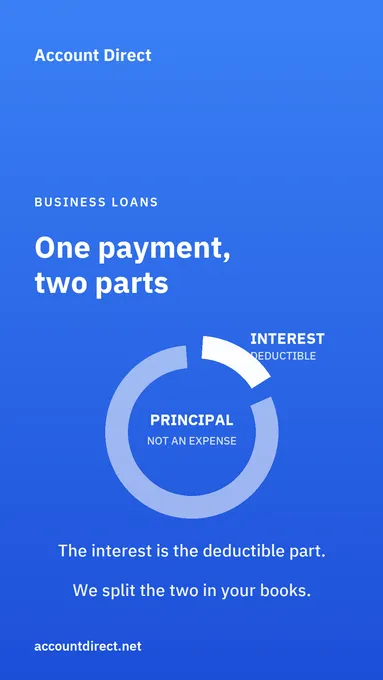
One payment, two different things
The lender takes one amount out of the account every month. Your books have to take that amount apart, because the two halves of it are treated in completely different ways.
The interest is the price of using someone else's money for a while. It is a cost of this year, and when the borrowed money is working in the business, it comes off your income.
The principal is your own money going back where it came from. It is not the cost of anything. It reduces what you owe and does nothing else.
One debit on the statement, two destinations in the books. Push the whole payment to either side and the return is wrong, in one direction or the other.
Why the interest side is deductible
Paragraph 20(1)(c) of the Income Tax Act allows a deduction for the lesser of a reasonable amount and the amount paid in the year, or payable in respect of the year depending on the method you regularly follow, paid pursuant to a legal obligation to pay interest on borrowed money used for the purpose of earning income from a business or property.
Every condition in that sentence is doing work. There has to be a real obligation to pay, the amount has to be interest, it has to be on borrowed money, and the money has to be used to earn business or property income.
CRA guide T4002 puts the ordinary case plainly: you can deduct interest on money borrowed for business purposes or to acquire property for business purposes. On form T2125 it lands at line 8710, Interest and bank charges.
Why the principal never was an expense
Paragraph 18(1)(b) denies a deduction for an outlay, loss or replacement of capital, a payment on account of capital or an allowance in respect of depreciation, except as expressly permitted. Handing borrowed money back to the lender is a payment on account of capital.
T4002 says the same thing in a single line inside its interest guidance: you can deduct the interest, but you cannot deduct the principal part of loan or mortgage payments.
Nothing is being lost here. The loan was not income when it arrived, so repaying it is not an expense when it leaves. Both movements belong to the balance sheet, not the income statement.
The deduction follows the use of the money
This is where the costly mistakes happen. People assume the deduction follows the name on the loan, or the asset pledged as security. It follows neither. It follows the use.
Income Tax Folio S3-F6-C1 sets out the test from the Supreme Court. The onus is on the taxpayer to trace the borrowed funds to an identifiable use which triggers the deduction, and interest is deductible only where there is a sufficiently direct link between the borrowed money and the current eligible use.
So a facility labelled a business loan that quietly funded a personal purchase produces no deduction, and a personal line of credit whose money went straight into business equipment may well produce one. What decides it is whether anyone can still follow the money years later.
What this looks like in the books
Ask the lender for the amortization schedule or the annual interest statement, then split every payment: interest to the expense account, principal against the loan balance.
Financing costs have their own timing. T4002 lists application, appraisal, processing and insurance fees, loan guarantee fees, brokerage and finder's fees and legal fees related to financing as deductible over five years at 20% a year, whatever the term of the loan, with the remainder deductible if you repay the loan early. A fee paid to reduce your interest rate, or a penalty charged for paying off a loan before it is due, is treated as prepaid interest and spread over the remaining original term.
A few limits are worth knowing before you assume the full amount comes off. The 2025 edition of T4002 caps the interest deductible on money borrowed to buy a passenger vehicle or a zero-emission passenger vehicle, restricts interest on vacant land, and rules out interest on money borrowed for personal purposes or to pay overdue income taxes.
We do this split every month rather than once in the spring, so the interest is claimed in full, the loan balance in the books matches the lender's, and nobody has to reconstruct a year of payments from memory.
Frequently asked questions
My loan payment comes out as one amount. How do I find the interest part?
Ask the lender for the amortization schedule or the annual interest statement. Most business lenders produce both, and online banking usually shows a year-to-date interest figure on the loan account. The split is not fixed: in an ordinary amortized loan the interest share is largest at the start, because interest is charged on the balance still outstanding, and it shrinks with every payment while the principal share grows. That is why one percentage applied to a whole year drifts away from the truth, and drifts in the same direction for twelve months. Book the interest to the expense account, book the principal against the loan balance, and reconcile the loan at year end so the closing balance in your books matches the lender's statement. When the two do not agree, the difference is almost always a payment that went entirely to one side.
I used a personal line of credit to pay for business equipment. Can I deduct that interest?
Possibly, because the test is what the borrowed money was used for, not whose name is on the credit facility or what secured it. Income Tax Folio S3-F6-C1 sets out the direct use test drawn from the Supreme Court: the onus is on the taxpayer to trace the borrowed funds to an identifiable use which triggers the deduction, and interest is deductible only where there is a sufficiently direct link between the borrowed money and the current eligible use. In practice, the tracing is the part that fails. Money drawn for a business purchase and then mixed with personal spending in the same account, over months, becomes very hard to follow, and a use nobody can trace is not an eligible one. If you borrow personally for the business, move the funds in one step, spend them on the one thing, and keep the paperwork that shows the path.