Faded receipts: do they still prove a business expense?
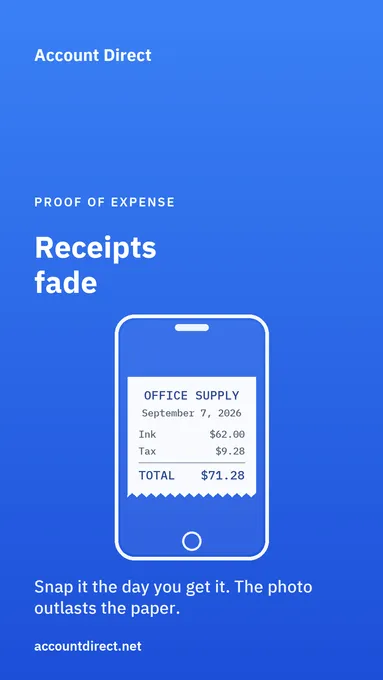
The paper gives out before the obligation does
Almost every till receipt you are handed is thermal paper. There is no ink on it. The image is heat printed onto a coating, and that coating keeps reacting to heat, light, friction and time long after you leave the store. Leave one in a glovebox over a summer, or in a folder next to a window, and you eventually pull out a clean white strip with nothing on it.
Nothing about that strip tells you it has expired. It is filed, it is in the right envelope, the count is right. It simply no longer says anything. The fading receipt does not fail loudly at the moment you need it. It failed quietly, months earlier, in a drawer.
What you actually have to be able to produce
Subsection 230(1) of the Income Tax Act requires every person carrying on business to keep records and books of account. Subsection 230(4) is the part that reaches the receipt: you have to retain those records and books of account, together with every account and voucher necessary to verify the information contained therein, until the expiration of six years from the end of the last taxation year to which they relate.
The voucher is the receipt. It is not a nice-to-have that supports the record, it is named in the retention rule alongside the record.
Quebec says the same thing in its own words. Section 35.1 of the Tax Administration Act requires you to preserve your registers together with any supporting document that supports the information contained therein, for six years after the last year to which they relate, and where they are kept on an electronic medium, to preserve them in intelligible form.
Intelligible is the operative word, and it is the standard a blank strip of paper cannot meet.
A blank receipt is a missing receipt
There is no partial credit for having kept it. If the document cannot be read, it verifies nothing, and the expense it was supporting is standing on its own.
RC4409, the CRA guide on keeping records, is short about the consequence: the CRA may disallow expenses that you are unable to support. The deduction is not lost because you spent the money on the wrong thing. It is lost because, years later, nobody can show what the money was spent on.
The photo is an accepted record, not a workaround
This is the part worth knowing, because people treat a phone photo as a second-best copy. It is not.
RC4409 states that supporting documents may be kept in either paper or electronic format, including electronic imaging formats, and that scanned images of paper documents, records or books of account maintained in electronic format are acceptable if proper imaging practices are followed and documented.
So the image is not a compromise. Done properly, it is the record, and unlike the paper it does not degrade.
What makes an image good enough
RC4409 describes imaging as generating a readable reproduction of the original source document, and sets out what that involves:
- an accurate reproduction, made with the intention of standing in place of the source document
- a reproduction that provides the same information as the source document
- a reproduction that is well defined, where the significant details are not obscured by limitations such as resolution, tonality or hues
In plain terms: the whole receipt in frame, all four edges, flat and in focus, no thumb over the total. Merchant, date, items, amounts and tax all legible at full size. Shoot it in decent light, and do not crop away the top or bottom because you think that part does not matter.
The habit costs ten seconds
Photograph the receipt while you are still standing at the counter, before it goes in a pocket.
That single change captures the record on the one day it is guaranteed to still be readable. Every day you wait, the odds get slightly worse, and you will not be able to tell when they turned.
Our clients photograph receipts and upload them from their phone. We file them, match them to the transaction in the books, and keep them where they can be produced for the full six years. The paper can fade after that. It has already done its job.
Frequently asked questions
My receipt has already gone blank. Can I still claim the expense?
Try to replace the document first. Most suppliers can reissue an invoice or email a copy from their own system, and a reissued document carries the same information as the original. If it cannot be recovered, understand what you are left with: CRA guide RC4409 states plainly that the CRA may disallow expenses that you are unable to support. A card or bank line plus a note written at the time of purchase, saying what was bought and why, is better than nothing, but it is weaker evidence than the receipt itself and it is the kind of gap that gets questioned in a review.
Once I have the photo, can I throw the paper out?
Be careful here, because the guidance is narrower than most people assume. RC4409 says you must keep the original version of records, but that you may produce an electronic image of a paper document which can then be accepted as the original record provided you follow certain procedures. Those procedures point to the national standard, CAN/CGSB 72.11, Microfilm and Electronic Images as Documentary Evidence. The practical answer for a small business: keep the photo as your working record, and keep the paper too for as long as it stays legible. It costs you a shoebox and it removes the question entirely.