Does a write-off make a business purchase free?
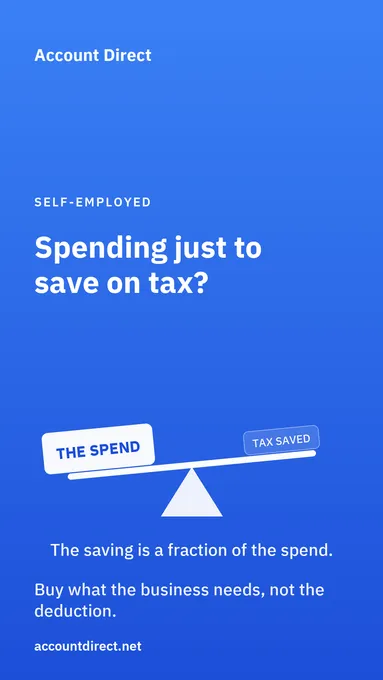
What a deduction actually does
Subsection 9(1) of the Income Tax Act fits in one sentence: a taxpayer's income for a taxation year from a business is the taxpayer's profit from that business for the year. Everything else follows from it.
A business expense does not touch your tax bill. It touches the profit, which is the number your tax is then calculated on. It lands one step earlier, not one step later.
The consequence is arithmetic. Spend 1,000 dollars on something fully deductible and your taxable income drops by 1,000 dollars. The tax you save is that 1,000 dollars multiplied by your marginal rate. At a marginal rate of 30 percent, used here purely as an illustration, you save 300 dollars and you paid out 1,000. You are 700 dollars poorer than before the purchase.
That is the balance beam in the video. The expense block is heavy, the tax-saved chip is light, and the beam never comes back level.
Not every dollar is deductible in full
Two rules trim that amount further before it ever reaches your income.
The expense has to be earning you money. Paragraph 18(1)(a) denies a deduction except to the extent the outlay was made for the purpose of gaining or producing income from the business. The personal share of a mixed purchase comes out of the claim, and making a reasonable split is your job, not the auditor's.
Meals and entertainment are halved. Subsection 67.1(1) deems an amount paid for the human consumption of food or beverages, or the enjoyment of entertainment, to be 50 percent of the lesser of what was actually paid and what would be reasonable in the circumstances. A 200 dollar client dinner becomes a 100 dollar deduction, and the tax saved is then a fraction of that 100.
Lasting purchases are not deducted this year
This is the misunderstanding that costs the most in December. Paragraph 18(1)(b) excludes an outlay on account of capital except as expressly permitted. CRA guide T4002 says the same thing plainly: you cannot deduct the initial cost of depreciable property in calculating the year's net income, but because the property wears out over time, you deduct the cost over a period of several years. That deduction is capital cost allowance.
So a vehicle, a piece of furniture, a machine or a computer bought on December 20 does not lower this year's income by the amount on the invoice. Rushing a purchase on December 31 to save tax empties a bank account immediately in exchange for a deduction spread across future years.
The part you genuinely get back
There is one exception, and it is the sales tax. If you are registered, the GST/HST you pay on a business purchase comes back dollar for dollar as an input tax credit against what you remit. That recovery really is complete.
But it is not a deduction, and the two do not stack. T4002 is direct about it: when you claim the tax as an input tax credit, you reduce the expense you report by that same amount. The tax comes back through the return, not through the income statement.
The test before a year-end purchase
Ask one question: would you buy it if there were no deduction at all?
If the answer is yes, buy it, keep the receipt, and the deduction takes care of itself. If the answer is no, the deduction is not a good enough reason, because it never hands back the whole amount.
Buy for the business, not for the write-off. We handle putting the expense in the right place, applying the right limit, and claiming the tax that is actually recoverable.
Frequently asked questions
Should I buy equipment before year end to lower my tax bill?
Rarely for that reason alone, and for two separate reasons. First, lasting property is not deducted in the year you buy it: paragraph 18(1)(b) of the Income Tax Act excludes outlays on account of capital, and the cost comes off instead over several years through capital cost allowance. A laptop bought on December 20 does not drop your income by what you paid for it. Second, even on a fully deductible current expense, the tax saved is only a fraction of the money spent. Buy because the business needs it, and let the deduction follow.
Do I get the GST/HST on the purchase back?
If you are registered, yes, and it is the only part that comes back dollar for dollar: an input tax credit reduces the tax you remit. But it is not a deduction, and you cannot count the same amount twice. CRA guide T4002 is explicit that when you claim the GST/HST as an input tax credit, you reduce the expense you report by that amount. A 100 dollar expense plus tax does not become a deduction of the full tax-included total.