Is a card statement enough proof for a business expense?
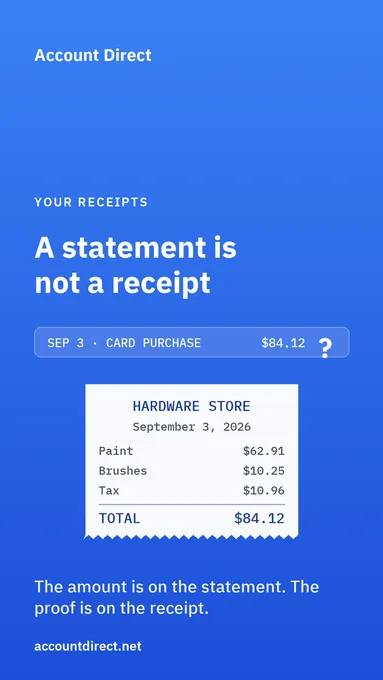
What a statement actually shows
Open your card statement and look at one line. There is a date, a merchant name, and an amount. That is the whole record.
What it does not show is what you bought, whether the purchase was for the business or personal, how much of it was tax, or whether the seller was even registered to charge that tax. Those are exactly the facts a deduction and a tax credit rest on, and none of them are on the line.
This is not a rule invented by an auditor. Section 230 of the Income Tax Act requires you to keep records in such form and containing such information as will enable the taxes payable to be determined. A line that says "84.12, hardware store" does not enable anything to be determined.
What the CRA asks the document to show
CRA guide T4002, the guide for self-employed business income, is unusually specific. It says to always get receipts or other vouchers when you buy something for your business, and that the receipts have to show:
- the date of the purchase
- the name and address of the seller or supplier
- the name and address of the buyer
- the full description of the goods or services
- the vendor's business number if they are a GST/HST registrant, when the purchase price is $100 or more before tax
A statement line gives you the first item and part of the second. The rest has to come from the receipt.
The same guide answers the obvious follow-up. If a supplier does not want to give you a receipt, get one anyway, because your transactions may be denied if you do not have the proper documentation to support your purchases.
The $100 line, and why it decides your tax credits
If you are registered for GST/HST, the expense side of your books does double duty: it supports the deduction, and it supports the input tax credit that reduces what you remit. The credit has its own documentary rule, set out in the Input Tax Credit Information (GST/HST) Regulations, and it is tiered by the amount on the document.
Under $100, you need the supplier's name, the invoice date, and the total paid. From $100 up to under $500, you also need the supplier's GST/HST registration number and the tax charged, or a statement that tax is included along with the rate. At $500 and over, add your own name, the terms of payment, and a description of each supply sufficient to identify it.
Notice where the thresholds bite. A card statement almost never carries a registration number, and it never carries a description. So on any purchase of $100 or more, the statement alone cannot support the credit, no matter how clearly it shows the amount.
The format is not the point, the information is
It is worth being precise here, because the rule is often stated too bluntly. The regulations do not ban statements. They define supporting documentation broadly: an invoice, a receipt, a credit-card receipt, a debit note, a book or ledger of account, a written agreement, or a record in an electronic system.
What matters is not the shape of the document but whether it carries the prescribed information. The receipt usually does. The statement usually does not. That is the whole distinction, and it is why keeping both is the right answer: the statement proves the payment cleared, the receipt proves what it was for.
The habit that fixes it
Photograph the receipt the moment you pay, before it goes into a pocket and through the wash. If the receipt has no description, write on it what you bought while you still remember. Then upload it.
We sort what you send, match it to the transaction on your statement, and keep the pair together for the six years the rules require. The work takes seconds at the till and saves an afternoon of reconstruction a year later.
Frequently asked questions
My receipt is a cash register tape with no description. Is it still good?
Yes, if you fix the gap yourself. The CRA addresses this directly in guide T4002: when there is no description on the receipt, as with a cash register tape, you should write what the item is on the receipt or in your expense records. Do it at the time of purchase, while you still remember what you bought. A tape that says only a store name and a total, with nothing added, is the kind of document that gets questioned in an audit.
I lost the receipt. Can I still claim the expense?
Ask the supplier for a duplicate first. Most vendors can reissue an invoice or email a copy, and a reissued document carries the same information as the original. If the receipt cannot be recovered, the statement line plus a contemporaneous note of what was bought and why is better than nothing, but it is weaker evidence: the CRA guide is explicit that transactions may be denied if you do not have the proper documentation to support your purchases.