How long do I have to keep my receipts and records?
The rule, in one line
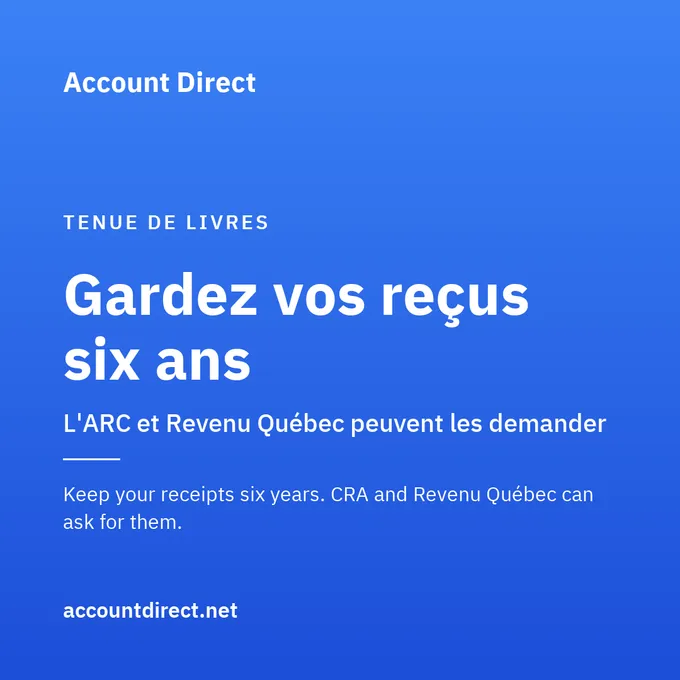
Keep your records and supporting documents for six years after the end of the last tax year they relate to. That is the rule at the Canada Revenue Agency, and Revenu Québec applies the same six-year period. It is not six years from when you feel like the file is closed. It is measured from the end of the tax year the document belongs to.
When the clock actually starts
Take a receipt from a purchase you made in March 2026, in a business whose fiscal year ends December 31. That receipt relates to the 2026 tax year. The six years run from the end of 2026, so you keep it until the end of 2032, even though you filed the return back in 2027.
Two practical consequences follow. Your oldest live file is always older than most people assume. And a receipt is not disposable the moment the return is filed and accepted; an assessment is not the end of the period during which the CRA or Revenu Québec can ask you to prove a number.
What counts as a record
More than receipts. Sales invoices you issued, purchase invoices you received, bank and credit card statements, contracts, mileage logs, payroll records, and the accounting books themselves. Anything that supports a figure on a return is a supporting document. If an auditor asked "where does this number come from," whatever answers that question is what you have to keep.
Paper or digital, your choice
You do not have to keep the paper. Revenu Québec is explicit that records kept on an electronic medium must be kept in an intelligible form on that medium for the same six years, and that you must take the measures needed to preserve their integrity throughout. Read plainly: a digital copy is fine, provided it stays readable and intact for the whole period.
That matters more than it sounds, because most store and gas receipts are thermal and fade to blank long before six years are up. A photo taken the day you get it will still be legible in 2032. The paper very likely will not.
The two exceptions worth knowing
A dissolved corporation. Records must be kept until two years after the date of dissolution. Winding up the company does not release you from the file.
Destroying records early. It is possible, but only with permission. The CRA asks you to file form T137 or write to your tax services office, and Revenu Québec asks for a signed written request. Until you have that authorization, the answer is to keep them.
How we handle it
Every document you send us is filed against the right year and kept for the full retention period, so the question "do I still need this" stops being yours to track. Send the receipt when you get it, and the six-year clock takes care of itself.
Frequently asked questions
Can I keep only digital copies?
Yes. Revenu Québec and the CRA accept records kept on an electronic medium, as long as you keep them in a readable form and preserve their integrity for the full six years.
Can I destroy my records before six years?
Only with permission. The CRA requires form T137 or a written request to your tax services office, and Revenu Québec requires a signed written request. Without that authorization, keep them.