Three restaurant expenses that get missed in the books
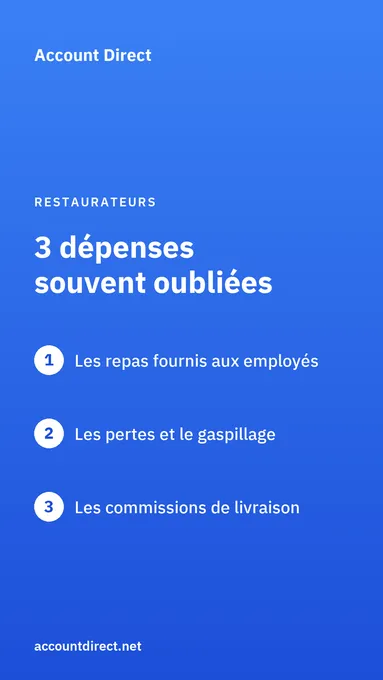
Three costs that quietly go missing
Restaurant margins are thin enough without leaving real costs off the books. Three of them get missed again and again, and not because owners are careless. Each one arrives without an obvious invoice to file, so nothing prompts anyone to enter it. Here is how each should be handled in 2026.
1. Meals provided to staff
Food you serve your own team is a real cost, and it is already sitting inside your food purchases. The question is not whether you can deduct it. It is whether the 50% limit applies.
Section 67.1 of the Income Tax Act deems an amount paid for food, beverages or entertainment to be 50% of the lesser of the amount actually paid and an amount that would be reasonable in the circumstances. That is the general rule. The same section then lists exceptions, and three of them matter to a restaurant:
- Food and beverages provided for compensation, in the ordinary course of a business of providing food for compensation, are outside the limit. The meals you sell to customers are inventory and stay fully in cost of goods sold.
- An amount that must be included in someone's income under section 6, as an employment benefit, is outside the limit as well.
- So are up to six special events in a calendar year, where the food is generally available to all employees at a particular place of business and consumed by them.
The taxable benefit side carries its own rule. The CRA's employer guide states that subsidized meals, such as in an employee dining room or cafeteria, are not a taxable benefit if the employee pays a reasonable charge, meaning one that covers the cost of the food, its preparation, and service. If the charge is not reasonable, the value of the benefit is the cost of the meals minus whatever the employee paid.
Staff meals are therefore not a single answer. They are a policy decision, and your bookkeeping has to match the policy you actually run.
2. Spoilage and waste
Here is the part that often gets stated backwards: spoiled food is not a bonus deduction claimed on top of your purchases. Cost of goods sold is opening inventory, plus purchases for the period net of discounts, minus closing inventory. Food that spoiled is not in closing inventory, so its cost is already inside cost of goods sold. You are not losing the deduction.
What you are losing is the information. A tomato that was thrown out, a tomato that was over portioned, and a tomato that walked out the back door all land in the same number if you never separate them. Tracking waste on its own line does not change your tax. It tells you which of those three problems you actually have.
Valuation is the one place this does touch your return. For income tax you may value your entire inventory at fair market value, or value individual items at the lesser of cost and fair market value. The second method lets you write stock that is still on hand but has lost value down to what it is now worth. Whichever you choose, you have to apply it consistently, and you need an actual stock count at the end of each fiscal period unless you run a perpetual inventory system.
3. Delivery platform commissions
This is the one that quietly distorts the whole picture. A delivery app does not send you what the customer paid. It sends the sale minus its commission, and the figure that reaches your bank is the net amount.
Record only that deposit and you have understated your sales and skipped an expense in the same stroke. The books still balance, and the revenue is still wrong. That reaches past the income statement, because your GST and QST are calculated on what you actually sold, not on what landed in the account.
The correct treatment is to record the gross sale as revenue and the commission as its own expense. The commission is a deductible business cost, and it is a service supplied to you, so if you are registered the GST and QST charged on it is recoverable as an input tax credit and an input tax refund, like any other input to your commercial activity. Booked this way, you also finally see the real number: what those orders cost you as a percentage, month over month.
The pattern behind all three
None of this is exotic. These are simply costs that show up without a supplier invoice in an envelope. If it never generates paper, it never gets entered, and by year end nobody remembers it happened. Catching them is a matter of giving each one a place in the books before the year starts, rather than hunting for them in the spring.
Frequently asked questions
Are the meals I give my staff fully deductible?
Not always. Section 67.1 of the Income Tax Act generally treats food and beverage costs as 50% deductible, but that limit does not apply where the amount is included in an employee's income as a taxable benefit, and it does not apply to up to six special events in a calendar year where the food is generally available to all employees at a particular place of business.
Do I record the gross sale or the net deposit from a delivery app?
Record the gross sale as revenue and the platform commission as a separate expense. Recording only the net deposit understates both your sales and your costs, and your sales tax is calculated on what you actually sold rather than on what reached your bank account.